Sunday, April 8, 2012

New life in an old building


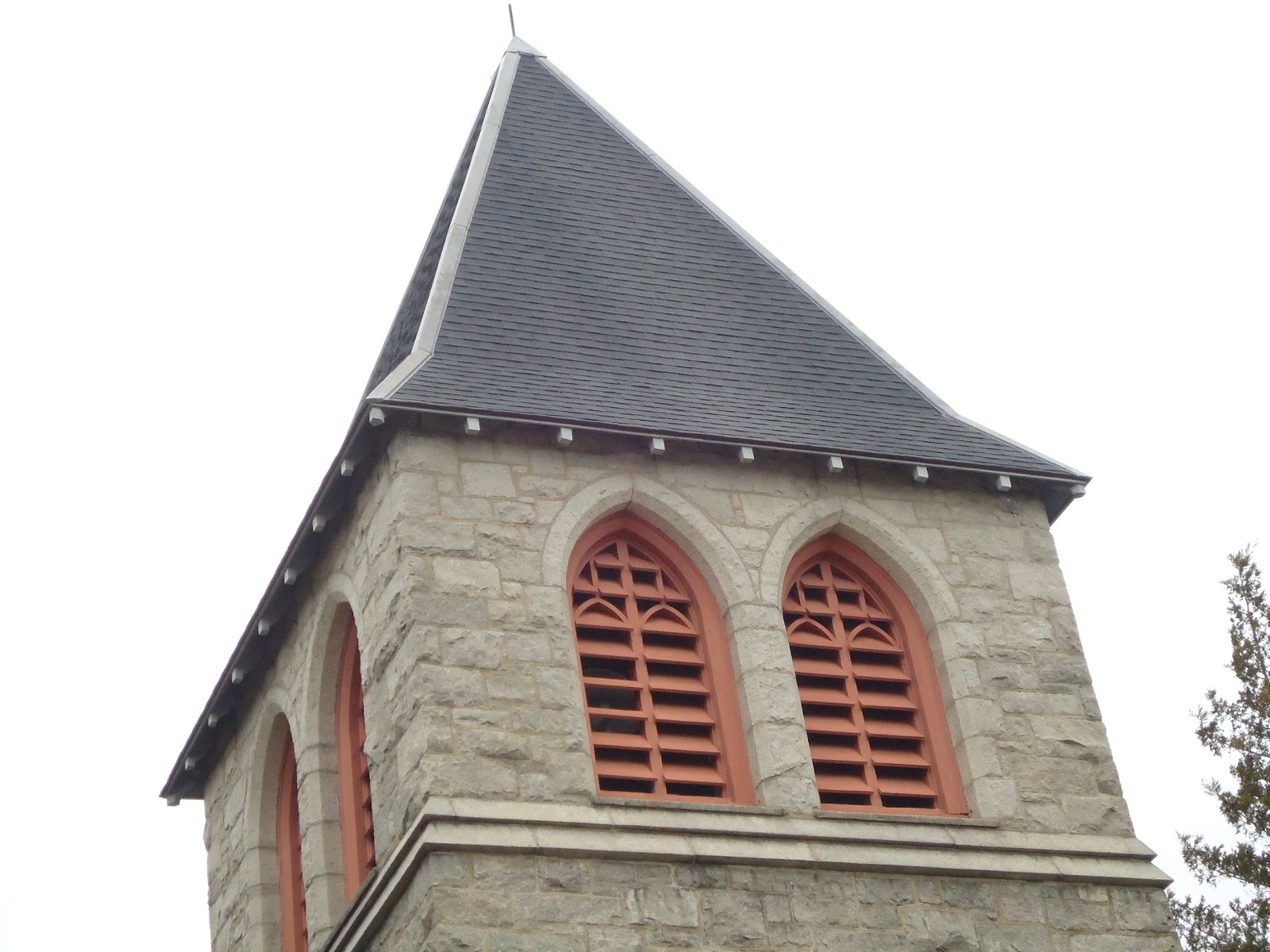
This solid-looking pyramidal steeple and bell tower grace the stately old Roger Williams Baptist Church in the Wanskuck neighborhood in Providence's north end.


I discovered this dignified gothic revival building, at the opposite end of Veazie Street from the Wanskuck Branch Library where I worked as branch librarian in 1998-99.  The church sits at the convergence of Veazie and Woodward Road.


The church was built in 1866 (1867 in some accounts) to serve the growing population of Providence's north end.  Much of this growth was related to the Wanskuck Co, founded in 1862 to produce textiles needed to make uniforms and blankets for the Civil war effort.


Sadly, the church closed in 2011 due to low membership, according to a story on the WPRI site.  Perhaps the decline reflects a much earlier population shift resulting from the close of the Wanskuck Co in 1957 as reported in a  short history of the Wanskuck neighborhood.


But there is good news for this old building - a new community of believers has recently purchased the property.  A  Providence Journal article reports that a new congregation, Christ Community Church, will move in later this month.    May God bless them as they bring new life to the building and to the community!


Friday, April 6, 2012

What happened to St. Mark's steeple?

St Mark's Church in Warren, RI presently has no steeple, although a tower existed at some point, as referenced in an Historical discourse delivered in St Mark's Church, Warren, RI [p 15] by rector William Nichols Ackley in 1878.
"On December 21st of this year [1839] a new bell, weighing 1950 pounds, was placed in the tower, the old one having broken.   Either a strange fatality must have haunted the bells of this church, or the good sextons must have displayed a singular energy in the ringing of them." 
Rector Ackley notes that the 1839 bell was the 3rd one purchased in the nine years since the church was built!


It turns out a hurricane weakened the bell tower and it had to be removed in 1945, according to an historical note from the Records of St Mark's Episcopal Church.  The records, which include annual reports, minutes of vestry meetings, parish registers, images, etc. are archived by Special Collections at the University of Rhode Island.


More curious than the missing steeple, however, is why the church would close its doors 2 years ago, after serving the Warren community for 180 years.  St Mark's, at 21 Lyndon Street, is located in Warren's eclectic historic district, and is currently for sale (asking price is $280,000).  A report on the WPRI web site blames a shrinking congregation and financial problems.  But why did the congregation decline?

Wednesday, April 4, 2012

Objectives of the Steeple Project

I have two objectives in creating this blog:  


I.  To maintain an informal catalog of some of my favorite architectural features: the STEEPLES and CAMPANILES (or BELL TOWERS) of Rhode Island and southern Massachusetts.  

Here's a classic example at left: the bell tower of St. Ann's Church on Russo Street in Providence, near where Branch Ave and Charles St intersect.  I see this lofty tower from Rt 146; it's like a guiding light when I'm driving after dark.

* * * * *
II. My second objective is a more philosophical/sociological effort: 
To note recent changes in the local church - particularly the closing of some local churches, the merging of some congregations, new designs of ecclesiastical architecture, and new patterns in which communities of faith choose to gather together - any of which might lead to the vanishing steeple of today's horizon.  It's also worth reflecting on how these changes are impacting our culture.

[Unless a specific source is cited, these observations are my own, as are the photographs.]

Tuesday, March 27, 2012

Steeples are vanishing from the skylines of New England cities and towns.  Does their disappearance signal a transformation of ecclesiastical architecture, or is it more indicative of a change in lifestyle, like the disappearing village green that stood, with the village church, at the center of town?